
Locked Out of Your House? Here’s What to Try Before You Call Anyone
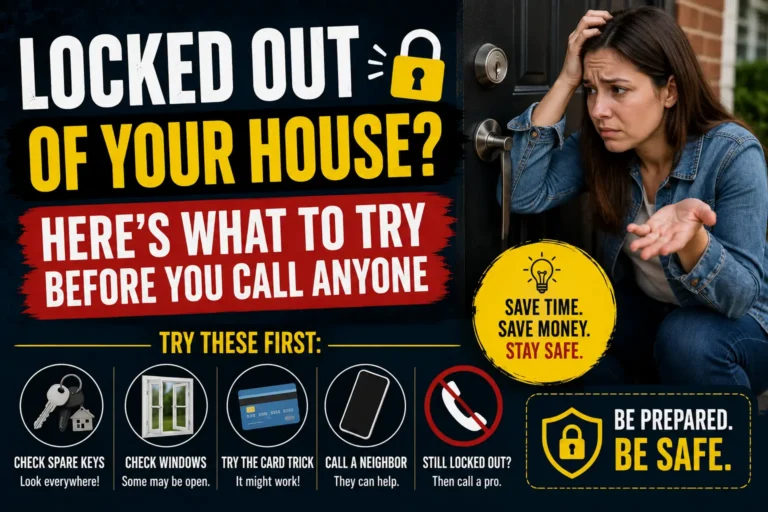
Getting locked out of your house is stressful, but most situations can be handled safely within a few minutes if you know what to check first. Before you call anyone, here is exactly what to try, in order, and what to avoid doing entirely, since a few common DIY methods cause more damage than the lockout itself.
Step One: Stay Calm and Check Your Own Safety First
Before anything else, take a moment to assess whether you are somewhere safe. If it is late at night, cold, or you are in an unfamiliar area, prioritize your own safety over trying to solve the lockout quickly. If you feel unsafe where you are standing, move to a well lit, public area or a neighbor’s porch while you sort out next steps.
Step Two: Check for Another Way In
Before calling anyone, check every door and any easily accessible window. Many homes have at least one entry point that was left unlocked, even if the main door is secured. This alone resolves a surprising number of lockouts without needing any tools or outside help at all.
Step Three: Think Through Who Might Have a Spare Key
A family member, roommate, neighbor, or landlord may already have a copy of your key. This is usually the fastest and completely free way back in, so it is worth a quick phone call or text before moving on to other options. If you rent your home, check whether your lease or property manager has a documented lockout policy, since some include a spare key service at no charge.
Step Four: Avoid These Common DIY Methods
It is tempting to try picking the lock yourself with a credit card, paperclip, or bobby pin, especially with online tutorials making it look simple. In practice, these tools often snap, jam inside the lock, or damage the internal pins, turning a simple lockout into a lock repair or replacement job. Prying at a door or window frame with a flathead screwdriver can also warp the frame, which is a far more expensive fix than the original lockout.
Breaking a window should be treated as a true last resort, only in a genuine emergency involving safety, not as a routine lockout solution. Window replacement, especially for larger panes, frequently costs more than a professional locksmith visit, and a broken frame can weaken your home’s security until it is repaired.
Step Five: Know When to Call 911 vs. a Locksmith
A standard lockout is not an emergency in the 911 sense, and emergency dispatchers may decline to send someone for a routine lockout. Reserve 911 for situations involving immediate danger, such as a medical emergency, a fire, or a child or pet in serious danger inside a locked home. For a standard lockout, a licensed locksmith is the appropriate call, not emergency services.
Step Six: Call a Licensed Locksmith
If none of the above options work, call a licensed locksmith and confirm three things before they arrive: their North Carolina locksmith license number, a total price including any after hours fee, and an estimated arrival time. Have a government issued photo ID or other proof of residency ready, since a legitimate locksmith should ask to verify you actually live at the address before opening anything.
What Happens Once the Locksmith Arrives
A professional locksmith will usually attempt to open your door using non destructive tools like picks or bypass tools first, which typically takes 20 to 30 minutes and causes no damage to your door or frame. If your lock happens to be a high security model that cannot be picked, the locksmith should explain this clearly and describe why a small, precise drill hole is needed instead of a large repair.
Preventing the Next Lockout
Once you are back inside, it is worth taking a few minutes to reduce the odds of this happening again. Keeping your keys attached to something you always carry, like your phone or wallet, is one of the simplest fixes. A secure, discreet lockbox for a spare key, or a smart lock with keypad entry, are both worth considering if lockouts have happened to you more than once.
Frequently Asked Questions About Home Lockouts
Is it safe to pick my own lock with a paperclip or bobby pin?
It is generally not recommended, since these tools can snap or jam inside the lock, causing more damage than the original lockout and often requiring a full lock replacement afterward.
Should I call 911 if I am locked out of my house?
No, unless there is an actual emergency involving safety, such as a fire or a person in immediate danger inside. A standard lockout should be handled by a licensed locksmith, not emergency services.
How long does it typically take a locksmith to resolve a home lockout?
Most home lockouts are resolved in 20 to 30 minutes once a licensed technician arrives, using tools that do not damage the door or lock.
Will a locksmith ask for identification before opening my door?
Yes. A locksmith following standard practice will ask for a government issued photo ID or other proof of residency before opening a home, which protects you as much as it protects them.
What is the best way to prevent future lockouts?
Keeping your keys attached to an item you always carry, storing a spare key in a secure lockbox, or installing a keypad smart lock are all effective ways to reduce the chances of another lockout.
Already tried everything and still locked out? Call Charlotte Locksmith Service at (207) 656-6060 for a same visit quote across Charlotte and Mecklenburg County.
North Carolina locksmith license #3001. Verify our license anytime at the North Carolina Locksmith Licensing Board, nclocksmithboard.org.
Need a licensed locksmith in Charlotte? Call (207) 656-6060 for a same visit quote.
(207) 656-6060